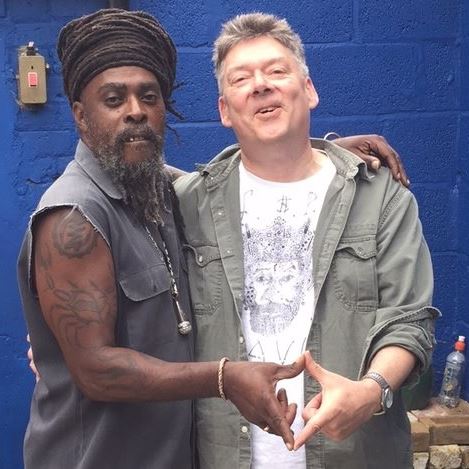
Duburbia Podcast, latest episode. Selecta J-Cut and guest, David Asher of DAB (David Asher Band), The Process and On-U Sound. click the link to hear the podcast.
Monday, July 13, 2020
Thursday, June 11, 2020
New: David Asher Interview and New Music From DAB!
Photo credit Bob Martuch
Now streaming on demand: David Asher, vocalist and songwriter of THE PROCESS and DAB (David Asher Band) is interviewed live on the The J Bone Show. David discusses his music career, alongside several tracks from THE PROCESS, and the debut of the "47 Shots (The Ballad Of Milton Hall)" from the forthcoming DAB album.
Saturday, April 18, 2020
Tape Op Magazine,
Check out the latest issue of Tape Op Magazine, which deals with mixers, engineers and producers etc. The latest issue is dedicated to reggae and dub, and they do interviews with Adrian Sherwood and Lee Perry as well as The Scientist and Emch Subatomic. Adrian's interview is very insightful and informative, and it's nice to be mentioned, along with THE PROCESS and DAB (David Asher Band) near the end. Here is a link to the interview:.
I remember the first time I heard the Dub Syndicate album, Tunesfrom the Missing Channel, in 1984. I was used to reggae being somethingearthy and warm, but here was a record that sizzled and popped with weirdsounds, synths, cut up spoken parts, and musical juxtapositions. I was hooked. I hold Adrian Sherwood and his On-U Sound Records label (founded in 1980) in high esteem, and I've always wanted to talk to him about his studio life. Sherwood's work with Tackhead, Dub Syndicate, African Head Charge, Creation Rebel, Mark Stewart, and so many others has changed the face of music. When he reunited with Lee "Scratch" Perry [see interview this issue] to produce the Rainford album, and its dub version, Heavy Rain, I finally got my chance to chat with him long distance.
Photo: Lee & Adrian in a still from the video for "Lies" by Sherwood & Pinch, ft. Lee "Scratch" Perry direction, edit, and effects by Sally Sibbet
I want to talk a little bit about your history. I got the impression that your early work was actually doing live sound system gigs inspired by the Jamaican style, right?
Sound systems? No. To be honest with you, I was a chancer.* I was a massive fan of reggae, James Brown, a lot of the black American funk and dance, Tamla [Berry Gordy's Motown], and everything as a kid. But then I became quite obsessed with reggae. I was lucky enough to get involved in the business through a Jamaican friend who worked for Pama Records in the '60s. I didn't really have a father; he was the person most like a dad to me, ever. He took me under his wing. Eventually I met musicians, cobbled together some releases, and started a little label. We went to do some shows; the first show was at the 100 Club, a famous club on Oxford Street in England.
Yep.
We had put together a band, all really last-minute, with Prince Far I, a legendary Jamaican DJ, chanting over the top. We were paying [for] a PA, and I was only maybe 19. I was leaning over to him and going, "More hi-hat! More bass! Turn up the vocal!" And he said, "Look, you do it! You do it!" He wasn't rude to me; he was like a chummy rock 'n' roll PA man. But we had a spring reverb, a [Roland] Space Echo or something, and he showed me, "There's the hi-hat, and there's that." I balanced it up, and put a little tiny effect on the snare and on the lead vocal. After the gig, people said, "Wow, that sounded amazing!" I think people had listened to it sound so badly [before]. I didn't know what I was doing! That was it.
You'd done releases? Had On-U Sound started before that?
No. I was involved as a junior partner in the Carib Gems label. Then I started the Hitrun label. After that came 4D Rhythms, and then On-U Sound at the end of 1980.
What were your first recording studio experiences?
My first studio one was through meeting artists. People always wanted me to run a session, and try and make some money however they could. I saved up. One of the people I was working for was called [Anthony] "Chips" Richards, who's a famous Jamaican character. He arranged for me to go into the studio with Dennis Bovell, who did The Slits, The Pop Group, and other records as well. I paid the musicians, and I hummed the bass lines to a bass player. I made an album called Dub from Creation [by Creation Rebel]. That was my first venture. I did it thinking, "Well, if I lose the 200 pounds I'm spending, it's not the end of the world. I'll have some fun!"
You're not a traditional musician, as far as playing an instrument, correct?
No, I'm not.
I love the idea of humming bass lines.
[laughs]
Traditionally with dub, one takes a song and deconstructs it; stretch it out, add effects, and drop instruments out. But you've always made new creations built to be dub tracks.
Pretty much, yes. I was involved in the whole dub scene, in one way or another, from very early on. We used to license tapes from Jamaica in the mid-'70s, when I was in my teens. A lot of the dub was created by record labels in London – they saw that there was a market for it. I was involved with that. Someone would come over, like [Henry] "Junjo" Lawes or one of the producers, and would have loads of dub versions left over from their songs. Those albums, Scientist Meets... whoever or whatever, they weren't real albums. People don't actually know it. Chris [Cracknell] at Greensleeves [Records] put them together and gave them the names. He basically took a load of dubs that had been mixed by Scientist [see interview this issue]. These people would evoke your imagination: King Tubby, Keith Hudson, Augustus Pablo, Scientist, and King Jammy. What Chris did, he put together these albums and said, "Oh, Scientist Meets... whatever," with funny sleeves, and people think they were actually conceived as a work! But they were put together out of dub versions by the record producer. People were sitting around, smoking a spliff, and listening to this. Interestingly, the first wave of reggae fans were the skinheads. They weren't racist; they were quite the opposite, working-class people who loved reggae. They liked the happy and funny and gimmicky records. But as soon as it became quite black – as black awareness happened in Jamaica and America; blaxploitation, the Black Panthers, Garveyism, and the Rasta movement – the crowds moved away from reggae, because it was too "black" for them. When dub came along, along came a "Smokey Bear," student-y hippie lot. It wasn't about having a lot of lyrics rammed down their throats, and a lot of them could get off on the instrumentals; the dubs. I made it for me as a fan. I was a fan of Keith Hudson's brand, a fan of Augustus Pablo's records, and obviously a big fan of the early King Tubby Meets The Upsetter – At The Grass Roots of Dub. I'd suddenly met these great musicians, like [Eric] "Fish" Clarke, and later [Lincoln] "Style" Scott, Errol "Flabba" Holt, Clifton Morrison, and Crucial Tony [Phillips] in London. I just started having some fun, as a fan. That's how it went.
Were you still having to hum bass lines and guide it?
Yeah, I was humming the bass! Or someone else came up with the bass line, or I'd come up with some lyrics. Some people are brilliant, brilliant songwriters. I'm a "part-songwriter."
What were some of the first records where you felt like you got your style going, as far as putting these dub records together?
Probably by the time we got to Mark Stewart's Learning to Cope with Cowardice album, and Staggering Heights by Singers & Players. The early African Head Charge was trying ideas. By then, I was definitely in good control of it.
What studios were you working out of then? How did you pick them and the engineers?
I'd work anywhere I could get a studio with an okay bit of equipment in it. We were responsible for popularizing Berry Street Studio. Gooseberry Sound Studios was established; I had gone to Gooseberry, and then, when that was very busy, I found Berry Street. A lot of people followed me down the same matrix. And with Southern Studios, that was where Crass and Björk, [when she was] in Kukl, did all their first records. I basically popularized that as a control room for doing Lee Perry, and sessions like that, in there. I'd work anywhere with decent monitors. Once I had a good engineer and knew what I was doing, I could work anywhere.
You mentioned decent monitors. With the dub you're working on, you need to hear the low end, right? Is that something you'd check out in a studio before booking it?
Yeah. You know as well as I, certain monitors sound great when you listen to them, but you can take them into another room and they're too bass-heavy. A room that you can trust and monitors you can trust are essential.
Right. I feel like with reggae and dub, you're dealing with so much information on the bottom end.
Yeah. It's a way of making the foot drum and the bass almost interlock; like two fingers interlocking.
What led other people seeking you out and asking you to produce them?
What happened for me was I knew Daniel Miller [Mute Records, Tape Op #110] from when he was living at his mum's house and put his first ever record out [as The Normal]. He said, "Oh, I wish we did an electronic dub album together," and we didn't. Then I was working with Mark Stewart, who he was a big fan of. He asked me to do one of his first remixes, which was "People Are People" by Depeche Mode. Then, after I did that, people started saying, "Oh, let's get Adrian in to do the weird remix!" They never got me to do the A-side! [laughter] In those days, they were all sniffed up idiots on cocaine; just fucking lunatics everywhere. What they would do is put out ten versions of a tune with a different picture sleeve, colored vinyl, and anything just to try and get a chart position. For me, I was always brought in to do the wacky remix to help bolster up somebody's chart position. That's how my career went. I didn't care, because I was just taking the company's money to bolster up my company!
That's an interesting parallel track, too. You were running a record label, which is something you learned beforehand through the distributors?
I'd been taught to try and build a catalog. If you want anyone to take you seriously, you have to have a catalog. That's how I was brought up.
Then you have a way to get those records heard and released.
"If I could make a record this week, I could probably have it out in a couple of weeks." I wish I could
do that now!
What kinds of projects have you worked on in the last five or ten years?
I am trying to reorganize myself with the label. In the last five years, I built up a relationship with Warp Records to reissue all my old stuff. They've been doing a really good job. There are loads and loads of records available. If anyone wants to check it, they can go online and have a look and see what's been made available. On the new release I did, I did a collaboration with Pinch [Rob Ellis], a producer from Bristol who's a good friend of mine. We did two Sherwood & Pinch albums [Man Vs. Sofa, Late Night Endless]. And I did an album with Coldcut at On-U Sound, Outside the Echo Chamber.
Right.
I did and album [#N/A] with Nisennenmondai, the Japanese band. I've been trying to strategically reposition myself in the market so that people even know that I've released anything. I don't know if you saw the album Pay It All Back Vol. 7 that we released, but that's highly recommended, if you can get ahold of it. It's a double vinyl, and it's all unreleased and forthcoming stuff from projects I'm about to do. It's also got a booklet with my complete catalog in it, listing all the productions. It's a beautiful little package.
That sounds perfect. I know you worked with Lee "Scratch" Perry in the mid-'80s, as well as on the recent Rainford album. He's a very mercurial, one might say. How do you go about keeping him focused on a record?
Well, on this one, I had a bit more access to him, so I spent a week with him at home with his wife in Jamaica. We mapped everything out in his kitchen late at night, working on headphones at the kitchen table. Then we brought it back here and did some more microscoping, hooks, and made it more song-like.
You did the rough versions of what he wanted, initially?
No; lots of it was masters, recorded on a low-quality mic. I also did some on a really high-quality mic, like a Neumann U 87. I've got this mixture of really intimate, raw vocals, straight in your face, mixed with other better-quality sounding songs. I also took some of his hooks and augmented them with backing vocals. That's how we created the record.
Were you playing him a rhythm in his headphones to toast over to start?
Yes, yes. Some of the rhythms we did from the beginning. Actually "Let it Rain" was done from beginning to end, that day. That was with the cello man, Ivan "Cello" Hussey, Skip "Little Axe" McDonald, and my daughters [Denise Sherwood Devenish, Emily Sherwood Hyman] doing the vocals. It was a very nice record.
Yeah, it's really cool. I love "Cricket on the Moon" and some of those tracks. They're just so playful, the way his mind works, obviously.
Look, I'll say this; it feels like my ego... but I think it's the best vocal album he's ever made. If you look at it, I'm very proud of Time Boom [from 1987], but in this album he reveals a lot of himself. It's song-oriented, and it's got loads of fun and seriousness all mixed together. I'm very happy with it.
Do you sometimes do sessions and bring people in, do some tracking, and see if these parts land on different projects?
I do, yeah. People have asked me that before. Well, not always. Very often I just start it thinking it's for something, and then sometimes I'm not quite happy with it. I might leave it for a couple of years and then revisit it, and if it's still got something I really like about it, then I'll reinvent it a bit. That kind of thing happens.
I really dug you solo album, Never Trust a Hippy, when it came out. It feels like a compilation record, in a way.
I can see why you'd think that. It is, a little bit. I did make the sonics sound complemented to each other. I used a lot of disparate parts. The whole thing was basically that you can rock to it. I can play it out, because I'd suddenly put myself [his name] on the front cover for the first time ever. I was doing gigs in my name. I had to put something out with my name on it, because being a producer without any record with your name on it is a bit difficult, except for the people who actually read the back of a sleeve.
Right. And your second solo record, Becoming a Cliche, was that a similar process?
That one I got a little bit more song-oriented, using my friends like Dennis Bovell and other collaborators like LSK [Lee "LSK" Kenny] and other people I really liked. I thought I'd make a pop song-y version of the record. I think that second album's maybe not as good as the first, but it has a lot of great tracks on it. The third one, Survival & Resistance, I think people don't realize how that was made. It's all made out of tuning. There're no synthesizers or anything on it. It's all made by mad tuning, and pitching, and bending.
No way! I've got to check that one out.
That's from about seven years ago. It's a great album.
How hands-on are you with work like that? Are you collaborating with an engineer, or mucking around on a computer?
Well, I tell people what to do. I'm like a little conductor, but I do use my fingers to shape everything, because I do it all analog. With the solo records I'm obviously like a little Hitler. I tell everybody what to do, 100 percent, and that's exactly what we do.
With analog, you're talking about the mixing process?
Yeah. But in the recording process I'm using the analog desk as an instrument, recording that, and then plunking it into another mix and playing things backwards and forwards. Just trying to make it breathe, really.
And utilizing effects?
Totally.
Do you have a ton of your own tape-based effects and spring reverbs that are very distinctive?
Everything, yeah.
What are some of your favorite spring reverbs that you use for drums?
Today I'm using a Grampian. [Probably a Reverberation Unit Type 636.] I got that for next to nothing, and they're quite expensive now. I've also got an old Orban from America that cost about $300. I use that for snare. It's a very tight, small reverb. People don't appreciate how good Orban is, but I love Orban stuff. [Probably a Model 111B.]
It's one of those light-blue ones?
Yeah. It's cheap and affordable still. I use the Fisher [Dynamic Spacexpander reverb], the same one that used to be in cars, that King Tubby used. They're quite useful to get that crap quality, but really good... I don't literally mean crap, but rather non-cultured or refined, like an AMS or something. It's a nasty lovely little edge. The color it brings: it's only got one sound, but if you put strings through it, it sounds like an Indian Bollywood distorted thing. Or you put it on a bass, or a guitar, or whatever, and that will cut your head off. It's wonderful.
That's one of the amazing things, if you look at the lineage from Jamaica. It's a lot of not top-of-the-line gear. Instead it's creative usage of that gear.
It's like a lot of those wonderful things, like Cinema Engineering [equalizers], Langevin [equalizers], and all that. They were all, in their day, made for the common man; like your first Ford car. Everyone could afford them. They weren't really, really expensive exclusive stuff. You can still get them, and they last the course of time.
Computer plug-ins are quite interesting, but it's not a piece of hardware that's going to follow you around for 30 years.
No. If you look at my studio now, the computer keeps breaking down much more than the vintage gear!
Do you have your own private place set up nowadays?
Yeah. I'm down by the seaside in a place called Ramsgate [in England]. It's a very interesting setup. The houses are about 200 years old. They're joined by gardens. We kicked the wall down, and you go in one house and go out another on a different road, which is very confusing for visitors. It's very funky, and really nice. I've actually got my friend from America, David Asher [THE PROCESS, David Asher Band]. He's visiting here, at the moment. He's sitting in the studio near the house as we speak. Skip McDonald, the great guitarist, is here as well.
Are there any projects in the future coming up that you are excited about?
I highly recommend that people look for Pay It All Back Vol. 7, because that finally gives a guideline to what's coming next. I've got an album done with Horace Andy that's absolutely stunning. I've got an album with my daughter Denise [Sherwood Devenish], which is wonderful. There's a taster for that on Pay It All Back Vol. 7. I've been recording African Head Charge, and I've got a few other things up my sleeve. I'm going to do another solo album myself. And 2020 is the 40th anniversary of the label.
Thinking back to the teenage kid who was you as a music fan, are you blown away at 40 years and all the releases you've worked on?
I'm just glad to be here still!
www.adriansherwood.com on-usound.com
"chancer" definition:
*One who takes manipulates situations to their own benefit. (English slang)
I remember the first time I heard the Dub Syndicate album, Tunesfrom the Missing Channel, in 1984. I was used to reggae being somethingearthy and warm, but here was a record that sizzled and popped with weirdsounds, synths, cut up spoken parts, and musical juxtapositions. I was hooked. I hold Adrian Sherwood and his On-U Sound Records label (founded in 1980) in high esteem, and I've always wanted to talk to him about his studio life. Sherwood's work with Tackhead, Dub Syndicate, African Head Charge, Creation Rebel, Mark Stewart, and so many others has changed the face of music. When he reunited with Lee "Scratch" Perry [see interview this issue] to produce the Rainford album, and its dub version, Heavy Rain, I finally got my chance to chat with him long distance.
Photo: Lee & Adrian in a still from the video for "Lies" by Sherwood & Pinch, ft. Lee "Scratch" Perry direction, edit, and effects by Sally Sibbet
I want to talk a little bit about your history. I got the impression that your early work was actually doing live sound system gigs inspired by the Jamaican style, right?
Sound systems? No. To be honest with you, I was a chancer.* I was a massive fan of reggae, James Brown, a lot of the black American funk and dance, Tamla [Berry Gordy's Motown], and everything as a kid. But then I became quite obsessed with reggae. I was lucky enough to get involved in the business through a Jamaican friend who worked for Pama Records in the '60s. I didn't really have a father; he was the person most like a dad to me, ever. He took me under his wing. Eventually I met musicians, cobbled together some releases, and started a little label. We went to do some shows; the first show was at the 100 Club, a famous club on Oxford Street in England.
Yep.
We had put together a band, all really last-minute, with Prince Far I, a legendary Jamaican DJ, chanting over the top. We were paying [for] a PA, and I was only maybe 19. I was leaning over to him and going, "More hi-hat! More bass! Turn up the vocal!" And he said, "Look, you do it! You do it!" He wasn't rude to me; he was like a chummy rock 'n' roll PA man. But we had a spring reverb, a [Roland] Space Echo or something, and he showed me, "There's the hi-hat, and there's that." I balanced it up, and put a little tiny effect on the snare and on the lead vocal. After the gig, people said, "Wow, that sounded amazing!" I think people had listened to it sound so badly [before]. I didn't know what I was doing! That was it.
You'd done releases? Had On-U Sound started before that?
No. I was involved as a junior partner in the Carib Gems label. Then I started the Hitrun label. After that came 4D Rhythms, and then On-U Sound at the end of 1980.
What were your first recording studio experiences?
My first studio one was through meeting artists. People always wanted me to run a session, and try and make some money however they could. I saved up. One of the people I was working for was called [Anthony] "Chips" Richards, who's a famous Jamaican character. He arranged for me to go into the studio with Dennis Bovell, who did The Slits, The Pop Group, and other records as well. I paid the musicians, and I hummed the bass lines to a bass player. I made an album called Dub from Creation [by Creation Rebel]. That was my first venture. I did it thinking, "Well, if I lose the 200 pounds I'm spending, it's not the end of the world. I'll have some fun!"
You're not a traditional musician, as far as playing an instrument, correct?
No, I'm not.
I love the idea of humming bass lines.
[laughs]
Traditionally with dub, one takes a song and deconstructs it; stretch it out, add effects, and drop instruments out. But you've always made new creations built to be dub tracks.
Pretty much, yes. I was involved in the whole dub scene, in one way or another, from very early on. We used to license tapes from Jamaica in the mid-'70s, when I was in my teens. A lot of the dub was created by record labels in London – they saw that there was a market for it. I was involved with that. Someone would come over, like [Henry] "Junjo" Lawes or one of the producers, and would have loads of dub versions left over from their songs. Those albums, Scientist Meets... whoever or whatever, they weren't real albums. People don't actually know it. Chris [Cracknell] at Greensleeves [Records] put them together and gave them the names. He basically took a load of dubs that had been mixed by Scientist [see interview this issue]. These people would evoke your imagination: King Tubby, Keith Hudson, Augustus Pablo, Scientist, and King Jammy. What Chris did, he put together these albums and said, "Oh, Scientist Meets... whatever," with funny sleeves, and people think they were actually conceived as a work! But they were put together out of dub versions by the record producer. People were sitting around, smoking a spliff, and listening to this. Interestingly, the first wave of reggae fans were the skinheads. They weren't racist; they were quite the opposite, working-class people who loved reggae. They liked the happy and funny and gimmicky records. But as soon as it became quite black – as black awareness happened in Jamaica and America; blaxploitation, the Black Panthers, Garveyism, and the Rasta movement – the crowds moved away from reggae, because it was too "black" for them. When dub came along, along came a "Smokey Bear," student-y hippie lot. It wasn't about having a lot of lyrics rammed down their throats, and a lot of them could get off on the instrumentals; the dubs. I made it for me as a fan. I was a fan of Keith Hudson's brand, a fan of Augustus Pablo's records, and obviously a big fan of the early King Tubby Meets The Upsetter – At The Grass Roots of Dub. I'd suddenly met these great musicians, like [Eric] "Fish" Clarke, and later [Lincoln] "Style" Scott, Errol "Flabba" Holt, Clifton Morrison, and Crucial Tony [Phillips] in London. I just started having some fun, as a fan. That's how it went.
Were you still having to hum bass lines and guide it?
Yeah, I was humming the bass! Or someone else came up with the bass line, or I'd come up with some lyrics. Some people are brilliant, brilliant songwriters. I'm a "part-songwriter."
What were some of the first records where you felt like you got your style going, as far as putting these dub records together?
Probably by the time we got to Mark Stewart's Learning to Cope with Cowardice album, and Staggering Heights by Singers & Players. The early African Head Charge was trying ideas. By then, I was definitely in good control of it.
What studios were you working out of then? How did you pick them and the engineers?
I'd work anywhere I could get a studio with an okay bit of equipment in it. We were responsible for popularizing Berry Street Studio. Gooseberry Sound Studios was established; I had gone to Gooseberry, and then, when that was very busy, I found Berry Street. A lot of people followed me down the same matrix. And with Southern Studios, that was where Crass and Björk, [when she was] in Kukl, did all their first records. I basically popularized that as a control room for doing Lee Perry, and sessions like that, in there. I'd work anywhere with decent monitors. Once I had a good engineer and knew what I was doing, I could work anywhere.
You mentioned decent monitors. With the dub you're working on, you need to hear the low end, right? Is that something you'd check out in a studio before booking it?
Yeah. You know as well as I, certain monitors sound great when you listen to them, but you can take them into another room and they're too bass-heavy. A room that you can trust and monitors you can trust are essential.
Right. I feel like with reggae and dub, you're dealing with so much information on the bottom end.
Yeah. It's a way of making the foot drum and the bass almost interlock; like two fingers interlocking.
What led other people seeking you out and asking you to produce them?
What happened for me was I knew Daniel Miller [Mute Records, Tape Op #110] from when he was living at his mum's house and put his first ever record out [as The Normal]. He said, "Oh, I wish we did an electronic dub album together," and we didn't. Then I was working with Mark Stewart, who he was a big fan of. He asked me to do one of his first remixes, which was "People Are People" by Depeche Mode. Then, after I did that, people started saying, "Oh, let's get Adrian in to do the weird remix!" They never got me to do the A-side! [laughter] In those days, they were all sniffed up idiots on cocaine; just fucking lunatics everywhere. What they would do is put out ten versions of a tune with a different picture sleeve, colored vinyl, and anything just to try and get a chart position. For me, I was always brought in to do the wacky remix to help bolster up somebody's chart position. That's how my career went. I didn't care, because I was just taking the company's money to bolster up my company!
That's an interesting parallel track, too. You were running a record label, which is something you learned beforehand through the distributors?
I'd been taught to try and build a catalog. If you want anyone to take you seriously, you have to have a catalog. That's how I was brought up.
Then you have a way to get those records heard and released.
"If I could make a record this week, I could probably have it out in a couple of weeks." I wish I could
do that now!
What kinds of projects have you worked on in the last five or ten years?
I am trying to reorganize myself with the label. In the last five years, I built up a relationship with Warp Records to reissue all my old stuff. They've been doing a really good job. There are loads and loads of records available. If anyone wants to check it, they can go online and have a look and see what's been made available. On the new release I did, I did a collaboration with Pinch [Rob Ellis], a producer from Bristol who's a good friend of mine. We did two Sherwood & Pinch albums [Man Vs. Sofa, Late Night Endless]. And I did an album with Coldcut at On-U Sound, Outside the Echo Chamber.
Right.
I did and album [#N/A] with Nisennenmondai, the Japanese band. I've been trying to strategically reposition myself in the market so that people even know that I've released anything. I don't know if you saw the album Pay It All Back Vol. 7 that we released, but that's highly recommended, if you can get ahold of it. It's a double vinyl, and it's all unreleased and forthcoming stuff from projects I'm about to do. It's also got a booklet with my complete catalog in it, listing all the productions. It's a beautiful little package.
That sounds perfect. I know you worked with Lee "Scratch" Perry in the mid-'80s, as well as on the recent Rainford album. He's a very mercurial, one might say. How do you go about keeping him focused on a record?
Well, on this one, I had a bit more access to him, so I spent a week with him at home with his wife in Jamaica. We mapped everything out in his kitchen late at night, working on headphones at the kitchen table. Then we brought it back here and did some more microscoping, hooks, and made it more song-like.
You did the rough versions of what he wanted, initially?
No; lots of it was masters, recorded on a low-quality mic. I also did some on a really high-quality mic, like a Neumann U 87. I've got this mixture of really intimate, raw vocals, straight in your face, mixed with other better-quality sounding songs. I also took some of his hooks and augmented them with backing vocals. That's how we created the record.
Were you playing him a rhythm in his headphones to toast over to start?
Yes, yes. Some of the rhythms we did from the beginning. Actually "Let it Rain" was done from beginning to end, that day. That was with the cello man, Ivan "Cello" Hussey, Skip "Little Axe" McDonald, and my daughters [Denise Sherwood Devenish, Emily Sherwood Hyman] doing the vocals. It was a very nice record.
Yeah, it's really cool. I love "Cricket on the Moon" and some of those tracks. They're just so playful, the way his mind works, obviously.
Look, I'll say this; it feels like my ego... but I think it's the best vocal album he's ever made. If you look at it, I'm very proud of Time Boom [from 1987], but in this album he reveals a lot of himself. It's song-oriented, and it's got loads of fun and seriousness all mixed together. I'm very happy with it.
Do you sometimes do sessions and bring people in, do some tracking, and see if these parts land on different projects?
I do, yeah. People have asked me that before. Well, not always. Very often I just start it thinking it's for something, and then sometimes I'm not quite happy with it. I might leave it for a couple of years and then revisit it, and if it's still got something I really like about it, then I'll reinvent it a bit. That kind of thing happens.
I really dug you solo album, Never Trust a Hippy, when it came out. It feels like a compilation record, in a way.
I can see why you'd think that. It is, a little bit. I did make the sonics sound complemented to each other. I used a lot of disparate parts. The whole thing was basically that you can rock to it. I can play it out, because I'd suddenly put myself [his name] on the front cover for the first time ever. I was doing gigs in my name. I had to put something out with my name on it, because being a producer without any record with your name on it is a bit difficult, except for the people who actually read the back of a sleeve.
Right. And your second solo record, Becoming a Cliche, was that a similar process?
That one I got a little bit more song-oriented, using my friends like Dennis Bovell and other collaborators like LSK [Lee "LSK" Kenny] and other people I really liked. I thought I'd make a pop song-y version of the record. I think that second album's maybe not as good as the first, but it has a lot of great tracks on it. The third one, Survival & Resistance, I think people don't realize how that was made. It's all made out of tuning. There're no synthesizers or anything on it. It's all made by mad tuning, and pitching, and bending.
No way! I've got to check that one out.
That's from about seven years ago. It's a great album.
How hands-on are you with work like that? Are you collaborating with an engineer, or mucking around on a computer?
Well, I tell people what to do. I'm like a little conductor, but I do use my fingers to shape everything, because I do it all analog. With the solo records I'm obviously like a little Hitler. I tell everybody what to do, 100 percent, and that's exactly what we do.
With analog, you're talking about the mixing process?
Yeah. But in the recording process I'm using the analog desk as an instrument, recording that, and then plunking it into another mix and playing things backwards and forwards. Just trying to make it breathe, really.
And utilizing effects?
Totally.
Do you have a ton of your own tape-based effects and spring reverbs that are very distinctive?
Everything, yeah.
What are some of your favorite spring reverbs that you use for drums?
Today I'm using a Grampian. [Probably a Reverberation Unit Type 636.] I got that for next to nothing, and they're quite expensive now. I've also got an old Orban from America that cost about $300. I use that for snare. It's a very tight, small reverb. People don't appreciate how good Orban is, but I love Orban stuff. [Probably a Model 111B.]
It's one of those light-blue ones?
Yeah. It's cheap and affordable still. I use the Fisher [Dynamic Spacexpander reverb], the same one that used to be in cars, that King Tubby used. They're quite useful to get that crap quality, but really good... I don't literally mean crap, but rather non-cultured or refined, like an AMS or something. It's a nasty lovely little edge. The color it brings: it's only got one sound, but if you put strings through it, it sounds like an Indian Bollywood distorted thing. Or you put it on a bass, or a guitar, or whatever, and that will cut your head off. It's wonderful.
That's one of the amazing things, if you look at the lineage from Jamaica. It's a lot of not top-of-the-line gear. Instead it's creative usage of that gear.
It's like a lot of those wonderful things, like Cinema Engineering [equalizers], Langevin [equalizers], and all that. They were all, in their day, made for the common man; like your first Ford car. Everyone could afford them. They weren't really, really expensive exclusive stuff. You can still get them, and they last the course of time.
Computer plug-ins are quite interesting, but it's not a piece of hardware that's going to follow you around for 30 years.
No. If you look at my studio now, the computer keeps breaking down much more than the vintage gear!
Do you have your own private place set up nowadays?
Yeah. I'm down by the seaside in a place called Ramsgate [in England]. It's a very interesting setup. The houses are about 200 years old. They're joined by gardens. We kicked the wall down, and you go in one house and go out another on a different road, which is very confusing for visitors. It's very funky, and really nice. I've actually got my friend from America, David Asher [THE PROCESS, David Asher Band]. He's visiting here, at the moment. He's sitting in the studio near the house as we speak. Skip McDonald, the great guitarist, is here as well.
Are there any projects in the future coming up that you are excited about?
I highly recommend that people look for Pay It All Back Vol. 7, because that finally gives a guideline to what's coming next. I've got an album done with Horace Andy that's absolutely stunning. I've got an album with my daughter Denise [Sherwood Devenish], which is wonderful. There's a taster for that on Pay It All Back Vol. 7. I've been recording African Head Charge, and I've got a few other things up my sleeve. I'm going to do another solo album myself. And 2020 is the 40th anniversary of the label.
Thinking back to the teenage kid who was you as a music fan, are you blown away at 40 years and all the releases you've worked on?
I'm just glad to be here still!
www.adriansherwood.com on-usound.com
"chancer" definition:
*One who takes manipulates situations to their own benefit. (English slang)
Tuesday, July 30, 2019
DAB (David Asher Band) working with On.U Sound.
David Asher has been busy in the UK, working on new DAB (David Asher Band) recordings, with the On.U Sound production team. A full length release is planned, stay tuned!
David Asher with Producer Adrian Sherwood.
David with vocalist Mikki Sound.
With Skip McDonald, Ghetto Priest and Adrian Sherwood.
At DWR Online Radio with John Oliver and Michael Jenkins, co-hosting "Roots Locker".
Sunday, June 09, 2019
The Process reviewed on the I-94 Bar website.
I-94 Bar, real rock action from Sidney Australia via the Bowrey and the Motor City. http://www.i94bar.com/
Who Is That Mad Band? - The Process (Temple Gong Recordings) & Dub World - The Process (Temple Gong Recordings).
You’d be right if you said reggae doesn’t get much of a look-in at the I-94 Bar. It's not that anyone’s allergic to it, but rock and roll is the staple beer on tap.
You can argue that the Clash turned out their own kind of rock-reggae with mixed results, but the genre remains at the margins around much of the world - like its distant punk rock cousin.
Bob Marley introduced the wider world to reggae in the ‘70s but it had been entrenched in Jamaica for generations. A generation of immigrants had already spread rocksteady and ska to the UK.
The music that Marley brought to stadiums and concert halls was a few steps away from the sound that pervaded the alleys of Trenchtown. Major labels provided th bread, not Jah, and their producers rubbed the rough edges off Marley, Peter Tosh and Jimmy Cliff to make them acceptable to mass market ears.
To be brutally honest, that Rastafarian patois that runs through the authentic stuff is impenetrable unless you’re staring down the business end of a two-metre spliff that's so potent you've convinced yourself that you’re the reincarnation of a dead African ruler. The social commentary that runs through the kyrics drifts over our heads like sacramental smoke.
Michigan band The Process isn’t a typical reggae act in most (white) peoples’ perception. They’r probably not even a typical Michigan band, whatever that is - half the world thinks of the Stooges but most Detroiters think of techno - also the area has a substantial reggae scene. The Process straddles turf of their own cultivation, where dub, syncopated rhythms, toasting and big grooves all merge with rock.
So some context: The Process have won innumerable awards in their home-town and have released a string of albums over 20 years. My curiosity from half a world away was piqued by the presence of Michigan guitar legend, the late Dick Wagner, as a guest on their 2016 album, “Who Is This Mad Band?”
Wagner (with Steve Hunter) was half of the flashy and fearsome guitar combo that made Lou’s “Rock and Roll Animal” a tour de force. He worked with Reed on the razor-blade-to-the-wrist classic that was “Berlin” and before that he was in The Frost, a local band that were contemporaries of the Stooges and the MC5 that never broke nationally. Dick played uncredited guitar on the early and great Alice Cooper group albums and went on to co-write songs on the Coop’s break-out opus, “Welcome To My Nightmare”.
The Process is based around founders David Asher (vocals) and Garrick Owen (guitar), with Bill Heffelfinger (bassist and programmer) P-Funk All Star Gabe Gonzalez on drums. The Process has collaborated with t Gorge Clinton, Stones sideman Bernie Worrell and a pile of dub and reggae people - even HR from hardcore pathfinders Bad Brains. Their music is reggae without strict limitations. To these ears, it’s closer to the dancehall and rocksteady music that presaged Marley and Co’s commercial success. It's syncopation that “rocks” in its own way.
Producer Adrian Sherwood, who has worked with Nine Inch Nails, Skinny Puppy, Ministry and KMFDM, had a hand in the sound of both albums. 2016's “Who Is That Mad Band?” has huge production and flows from track-to-track like, er, the River of Babylon. There's no denying the hypnotic pull in reggae rhythms. The requisite deep bass lines are there but so are horns, programming, high-energy rock guitar and lush keys. Dick Wagner’s scorching guitar is all over “Dr Jekyl and Mr Hyde”, a skanking attack on big pharma and cops, but there's plenty more to intrigue as the music morphs its way through a Baker's dozen of tracks.
“Dub World” (2017) is a companion to "Who Is That Mad Band?" comprising remixes and assistance from Sherwood, Skip McDonald aka Little Axe, Ghetto Priest and Lee "Scratch" Perry. Its big dub sounds are littered with treated vocals that wrestle with gritty fuzz guitar. Sax and layered keyboards weave in and out.
Wagner guests again on one track (“Interstellar Medium”) and there’s a cast of dozens augmenting the core band with additional instrumentation.
It's closer to "Maggot Brain" than "Metallic KO" but don't let that stop you.
Written by The Barman on 09 June 2019.
Thursday, April 04, 2019
On U Sound Sunday Roast in the Dub magazine
The On U Sound Sunday Roast program, hosted by David Asher was just featured in
By Dani Cameron.
On-U Sunday Roast Show, hosted by David Asher of band The Process, comes out every month and is filled to the brim with new and unreleased material, rarities, deep cuts and more from Adrian Sherwood’s On-U Sound label.
The label has been on a resurgence in the last few years, with an extensive reissue programme courtesy of Warp Records and numerous new projects for old friends and collaborators of On-U, as well as some exciting new projects. Adrian Sherwood has been very busy at the On-U HQ in Ramsgate, recording new albums with Horace Andy, Lee Scratch Perry, Little Axe and many more along with the return of the classic On-U Sound compilation series, “Pay It All Back” (expect a review in the next issue).
All this music gets previewed on the On-U Sunday Roast Show. The show originally grew out of the ‘baked tape’ project which involved Adrian and Patrik Dokter. Patrik has been recovering lost outtakes and unreleased gems from master tapes that were rotting away in storage. This music has started appearing on albums by Dub Syndicate, African Head Charge and Mark Stewart, as well as compilations entitled “Sherwood At The Controls”, with more planned – another album of lost music by African Head Charge is due for release this year and work is underway on the next Dub Syndicate collection.
David Asher’s band The Process has recorded with Adrian Sherwood and Skip McDonald, involving several Detroit-Ramsgate visits, which led to David volunteering to make the show a regular, rather than occasional feature. I have to salute David for succeeding in reflecting the sheer diversity of music that has passed through Adrian’s mixing desk in the show, whether it is previews of forthcoming work by LSK, Denise Sherwood and Ital Horns (all of whom have ongoing album projects at On-U Sound) or digging deep for remixes or obscure tracks by Singers And Players or Little Annie Bandez. Stylistically, there is no fixed pattern, but the signature production is
apparent throughout each episode. The label has released absolutely stacks of high class reggae, but has also broken down barriers in funk, rock, industrial, experimental, blues and jazz music. As they say, if you don’t know, get to know.
David Asher and Adrian Sherwood in Ramsgate.
Monday, April 01, 2019
DAB (David Asher Band)
DAB (David Asher Band) is the Roots Reggae project of THE PROCESS vocalist David Asher.
Click here for more information.
Tuesday, January 01, 2019
Now streaming on demand: Legendary Dub Music Producer Adrian Sherwood guest hosts a special Christmas/New Years mix on the ON.U Sound Sunday Roast, on DWR Online Radio. Adrian showcases almost 70 minutes of new, forthcoming, classic, and unreleased music from On-U Sound Records and it's associated acts. David Asher hosts.
Thursday, July 05, 2018
Remembering SETH PAYTON Paying Tribute to the Spark of a Musical Maverick
Seth Payton
By: Robert E Martin From Review Magazine.
Although possessed of a small, lean and ultimately frail body, our community lost a powerful & significant musical and spiritual force far more expansive than the Mid-Michigan region Seth Payton inhabited physically when he sadly passed away on June 11th, finally succumbing to a six-year battle against cancer, which finally took this 36-year old musical beacon away from us to blaze new trails in the World Unseen far too soon.
By: Robert E Martin From Review Magazine.
Although possessed of a small, lean and ultimately frail body, our community lost a powerful & significant musical and spiritual force far more expansive than the Mid-Michigan region Seth Payton inhabited physically when he sadly passed away on June 11th, finally succumbing to a six-year battle against cancer, which finally took this 36-year old musical beacon away from us to blaze new trails in the World Unseen far too soon.
As co-founder of the ground-breaking, horn-fueled, and creatively innovative Ska-Punk band STAMP’d, which exploded upon the Mid-Michigan music scene back in 1996 with the force of a tornado sweeping up all the audiences it encountered into its funnel of musical transcendence, Seth Payton emanated an equally powerful spiritual presence, possessing a strength he believed could move mountains. And in more ways than one, it did.
The first time I saw STAMP’d was at White’s Bar and it was one of those handful of musical experiences that one is lucky enough to encounter a handful of times in this lifetime. The rhythm and percussion were full and working in tight syncopation from numerous sources within the band; the guitars were driven, clean, and possessed; and the 3-member horn section, which Seth would play sax and pen soaring and original arrangements for, locked the entire room in syncopated harmony. When he wasn’t playing or singing, Seth could be seen dancing like a whirling dervish into the crowd….sucking up any butt that wasn’t moving into the energy of that musical and spiritual funnel Seth magically possessed, like a true Shaman.
It wasn’t long before STAMP’d became one of the biggest groups on the circuit - performing a trail-blazing set of original music mixed with unfamiliar covers that drew more audiences to the dance-floor than the average cover band could hope to cover in their wettest of dreams. They won numerous trophies at The Review Music Awards in the nineties, earning honors for their ground-breaking work as Best Original Band, Best Alternative Band, and Best Variety Band to name but a few.
Seth studied music with his saxophone at SVSU, but was also a self-taught, accomplished musician whose passion to play many styles of music and instruments was extraordinary. His infectious smile, sense of humor, sense of self, and compassionate spirit endeared Seth to everyone he met.
Phil Garno co-founded STAMP’d with Seth back in the 1990s and worked as a close collaborator and friend to Payton through many of their formative years. “Seth and I grew up together in Birch Run,” recalls Garno (now living in Boston). “We started a band in High School around 1996 that would later become the ska band STAMP'd. In our first line up, Seth played keyboard, multiple Saxophones, Conga, and pretty much everyone else's instruments in the band, begrudgingly often better than we did.”
“Seth was a showoff and rightfully so,” continues Garno. “He also was known to occasionally do a back flip off the stage. His energy level was unmatched then, and also later in life. His energy was a positive force that you couldn't help but get on board with.”
“To my mind, his musicianship raised the bar for our band, and I'm guessing everyone who played with him. He orchestrated all the parts including solo riffs for other members. He would score music for some, clap out rhythm for others, or tab out and patiently teach parts to us as needed. I cannot imagine what my life would be like without Seth Payton.”
In an interview with Review around the time Seth was first diagnosed with his illness and a benefit concert was being staged at White’s Bar to help him pay some of his mounting medical bills, he had this to say. “When we started the punk-ska band STAMP’d, I just liked the music. But I grew into reggae, or maybe I’m just getting older. I’m appreciating more music.”
After STAMP’d closed up shop, Payton went on to join forces with David Asher of The Process and David Asher (DAB) Band. He also would DJ with Asher as part of Shaolin Sound System. In addition to arranging the horns for The Process latest release and performing on several of the songs, he also released a reggae album with his own band, Roach King & the Resonators. He even wrote a country song, he said, in the style of classic country.
“The funny thing about Seth was how many people who met him regarded him as their best friend, and in a way, he really was,” recalls long-time friend and musical collaborator David Asher. “Seth had a way of making you feel good when he was with you, and when he left he took that feeling with him. The strange thing is I feel him with me now, and if that feeling is going to be hanging around, I’m good with it, because that is what we have. Still, I’d much rather have him here with us.”
“Seth was such a natural musician, and talented on so many instruments - he could always bring just the right "feel", and was always fresh and unique in his approach,” continues Asher when discussing Payton’s numerous musical gifts. “He was a crowd exciter too, and we were blessed to have him perform with THE PROCESS and DAB many times.”
“Seth was God’s man,” states Asher. “He fought his way back from his initial illness with such fortitude, we all believed he would beat the terrible odds and recover. When God healed him and he was performing and doing music again, he gave God the glory. When his sickness returned with a vengeance, he never wavered in his faith or cursed God, he held firm.”
“I see so much of Seth in his 10-year old daughter Faith, and what a perfect name for her, she is a beautiful legacy for him. Seth was a bright, shining, burning star. We will never have someone quite like him again, that is for certain.”
“I saw him about a week and a half before he passed and he was in terrible shape, but still had that wonderful smile when I saw him,” concludes Asher. “In the end he never lost that smile, filled with love, even when he was unable to speak and in terrible pain. When I left we were both in tears.”
“With DAB he was finally playing bass in the Reggae project he had always wanted to do, and I know he was very frustrated having to step down, just as we were starting to take off with it. He gave me the courage to take a new road, and to start the new group. We had so many plans, and everything from here on out is from the momentum of them, and what he gave us.
“I will miss him terribly, and we will carry this music forward in his honor.”
The David Asher Band will be performing a special show in Seth’s honor at Scotty’s Sandbar on Friday, July 6th.
Monday, June 18, 2018
The Echo Chamber program
The Echo Chamber program on KAFI 90.3 FM Minneaplois 106.7 Saint Paul played THE PROCESS "Time Has Come" (in memory of Process bassist Seth Payton) on 6/13/2018.
Click to Listen!

Click to Listen!

Monday, June 11, 2018
Seth Payton Passes
It is with profound sadness that The Process and DAB (David Asher Band) must accept the passing of our beloved friend, band-mate and brother, Seth Payton.
Seth fought a long and couragous battle against his illness, and in doing so, showed us all, through his example, the strength and spirit of a lion.
Our deepest condolences go to out to his daughter Faith, his mother Michelle, and the rest of his family and loved ones.
Be at peace Seth, you are always loved, and will never, ever be forgotten by all who knew and loved you.
Monday, June 04, 2018
New vinyl release featurng THE PROCESS!
OUT NOW! "Escape Velocity: 20 Years Onward to Andromedub"
Double vinyl and digital. Get your vinyl copy now, featuring "Return The Treasures" and "Treasures Dub" (vinyl only) from The Process with Ghetto Priest, Little Axe, Adrian Sherwood and Lee Perry! Cheapest option is directly through the Dub Flash website:
Saturday, May 26, 2018
The Process Reviewed in Duff Guide To Ska!
"Great review of THE PROCESS latest releases in The Duff Guide To Ska:
On the fantastic Who Is That Mad Band? and its great track-for-track dub companion Dub World (CDs/digital, Temple Gong Recordings, 2016 and 2017), Detroit's The Process play a wild, heady mix of '70s rock and roots reggae with new wave-synths and metal theatricality--all of which works surprisingly well. The band stands tall on their own with tracks like "Dr. Jekyll and Mr. Hyde" which features the legendary (and late) Detroit rock guitarist Dick Wagner, "Mystery Babylon" "Dear Mr. Fantasy," and "Gypsy Wind." But then they have several excellent cuts mixed by On-U Sounds' Adrian Sherwood ("Time Has Come," "Return the Treasures") and David Harrow ("Fire Is Burning Version")--and others that feature Skip "Little Axe" McDonald (Sugar Hill Records' house band that recorded "The Message" and "White Lines" for Grandmaster Flash and the Furious Five, Tackhead, Dub Syndicate), Ghetto Priest, and the inimitable Lee "Scratch" Perry himself! The Process are yet another great act from this town that spawns them like crazy--Detroit again for the win." Review by Steve Shafer
Thursday, May 10, 2018
The On U Sound Sunday Roast has been Nominated for a 2018 Mixcloud Award!
Big news!
The ON.U Sound Sunday Roast radio show Hosted by David Asher has been nominated for a 2018 Mixcloud Award for Best Online Music Show, Reggae/Dancehall in 2018! Big up On-U Sound Records and Dance Web Radio!
"After reviewing thousands and thousands of entries, you are officially among the best-of-the-best when it comes to online radio. Not bad, right?
Over the next 10 days, our esteemed panel of industry judges will be reviewing all the finalists and deciding the winners.
Meanwhile, all finalists are also eligible to win a Listeners' Choice Award, which will be chosen by the public."
Monday, January 15, 2018
THE PROCESS – Dub World Review on DMME
Temple Gong 2017
Beamed up to be taken aback and out of Babylon, Rasta troopers from Detroit readjust their altitude – not attitude.
It’s quite unusual for a genre as firmly rooted as reggae to be reaching for the stars, yet that’s exactly what the members of this Michigan ensemble do on “Dub World”: the album with a deceptively telling title where emphasis is on the second, not first word. A continuum created here is conceptually cosmic-minded and positively spaced-out as outlined by “Arc Of Infinity” – rolling on a bass-and-drums lock and forming a formidable slab of dub.
It can’t be solid by definition. “Molecular Cloud” is initially distilled to percussion before hazy shades of other instruments flow in and out of focus, whereas “Galactic Halo” offers a condensed dance experience whose tense throb is caressed with an acoustic guitar lace and David Asher’s soulful singing. But if the belligerent chant of “Computronium” throws a technologically advanced Babylon to the farthest orbit, the epic “Dark Matter Shift” cuts a delicate shape out of nebulous brass and barely-there ivories
Most of the melodies would sound familiar to those who swayed to the rhythms of "Who Is That Mad Band?" as that album’s follow-up is revisiting old haunts to reveal their previously concealed recesses and color them differently. As a result, “Android Specie” has an 8-bit playfulness to its effects now which spice up its heavy groove and propel the piece, oiled with slide guitar, towards triumphal climax, while the less inflammable riffs of “Interstellar Medium” and “Escape Velocity” gained an abstract consciousness for greater, prog-stricken impact, what with the vestiges of vocals in the mix.
It’s sweet, siren-like voices that make “Magnetosphere” so riveting, though, so this is a world alluring enough to get in and never want out… until the next adventure looms on the event horizon.
Sunday, December 03, 2017
DUB WORLD Review in THE DUB Magazine.
The new album from THE PROCESS "DUB WORLD" was just reviewed in the Online UK zine "THE DUB". Check it out!
Recommended: THE PROCESS: DUB WORLD
The Process are a rock band from Detroit, Michigan, a city with a long and outstanding part in the history of music – one of the homes of the Blues in the great American migrations of the 1920s, the city that gave the world Motown, the Stooges and MC5, adopted home of Funkadelic in the 1960s and 70s as well as the home of techno just to name a few. But The Process are no ordinary rock band. They take all of the influences of their city’s music history and fuse it with a deep and abiding love of reggae. Band leader David Asher also runs a reggae sound system called Shaolin and hosts the monthly online On-U Sound radio show.
My personal highlight on this album is ‘Return The Treasures’, a song that features singer Ghetto Priest and Lee ‘Scratch’ Perry with a top class sweet reggae mix from Adrian Sherwood. The song addresses the treasures of Ethiopia held in Britain since their time in North East Africa in the nineteenth century, an issue raised regularly by Ras Seymour McLean (see feature in next month’s issue) as well as by the Ethiopian government. The so-called treasures of Magdala were taken from Ethiopia by British troops following a battle in 1868 and include an 18 carat gold crown and many religiously significant ancient manuscripts as well as nine tabots (wooden altar slabs) which are deemed so holy that the British Museum has promised to never display them, although there was an exhibition of many of the other items at the British Museum just under 10 years ago.
The album “Dub World” is an extensive dub reworking of their album ‘Who Is This Mad Band?’ There are songs on the ‘Dub World’ album that mark The Process out as a strong and powerful voice, one that takes in phuture dub, atmospheric electronica, funk and rock as well as more reggae. A favourite of mine is ‘Magnetosphere’ which sounds like Style Scott’s Roots Radics stateside at RAS Records or an old production of Adrian Sherwood with its synth washes and cut up samples of cult writer William Burroughs. The whole album features song titles that could be straight out of a classic Scientist album - ‘Molecular Cloud’ which features a nyahbinghi heartbeat at its core and the echotastic dubbed out ‘Dark Matter Shift’ being particular favourites. Interestingly, The Process have had Scientist produce the ‘Fire Is Burning’ EP for them. Another standout track is ‘Dear Mr Fantasy’, which is remixed by Oicho (an electronic dub nom de plume for David Harrow, who, in addition to his own varied career, played keyboards for Dub Syndicate and On-U Sound System), which has a great dubby bounce.
Ghetto Priest and David Asher (The Process)
Review by Dani Cameron
Sunday, October 29, 2017
October 2017 On U Sound Sunday Roast. Dub Syndicate World Exclusive, Pats Doctor Interview + more!
A very special October 2017 edition of the ON.U Sound Sunday Roast. The show features a worldwide exclusive of tracks from the new Dub Syndicate album "Displaced Masters", other rare and unreleased tracks, and an interview with On-U Sound Records archivist Pats Dokter. First broadcast on DWR Online Radio. Hosted by David Asher.
Thursday, October 05, 2017
DUB WORLD • David Asher & The PROCESS Create a Parallel Musical Universe
New Music in REVIEW
Posted In:Arts & Entertainment, Local Music, National Music, Artist Feature | From Issue 851 | By: Robert E Martin | 05th October, 2017
The new release by contemporary Reggae advocate, ambassador, songwriter, and innovative producer David Asher is titled Dub World - an engaging remix of stellar tracks cultivated from his last groundbreaking 2016 outing Who Is That Mad Band? with The PROCESS.
Consisting of 11 tracks and produced by The Process and Chris Lewis, with additional production courtesy of On U Sound legends Adrian Sherwood, Skip McDonald and David Harrow, the remixes on Dub World unveil like a tapestry of hypnotic tonal, rhythmic, and electronic clarity that shimmers with strong melodic musical hooks and shines like freshly minted coins embedded with fresh musical re-invention.
With nine albums and CD’s under their belt and numerous remixes, as the CD has fallen by the wayside in recent years, Asher’s new approach to recording is to focus upon releasing fresh singles to keep the band constantly churning in the in the stream of commerce with fresh material; but given that Mad Band took seven years to record, mix and release – which was time well spent insofar as it is hands-down the group’s most accomplished and accessible work – the genesis for Dub World started right after the release of Mad Band two years ago.
“We didn’t want to take a break,” states Asher, “and saved all the balance and EQ settings from that album, so we could strip the mixes back and add effects and whatever else we chose to do to make the tracks unique. That’s what Dub Mixing is all about.”
Consequently, the track titled Interstellar Medium, which features the late great Dick Wagner, is a radically remixed version of the track that appeared on Mad Band, as Asher was able to take the rhythm tracks and strip back effects in the original mix and add additional plug-ins and effects, as opposed to musical hardware on the project. “Basically because everything was recorded digitial, we are able to move parts of the song around because we can,” Asher explains.
“The whole purpose for Dub Releases is to present an alternate version of the song that exists in a parallel universe,” he continues. “I’ve always admired Jamaican music and remixes are a big part of it. People like legendary Jamaican producer Lee ‘Scratch’ Perry are always screwing around with the sound, so what I wanted to do with Dub World is create more of a futuristic album with a futuristic sound.”
The initial reaction has been quite good and Asher says both the new Dub World and Who Is That Mad Band? Have both been selling well online and at live shows performed with his latest project. The DAB Band. “I did a limited run of Dub World to test the waters but sold so many the first day of its release both online, and later at shows, that I need to press a few more.”
It’s been a busy summer for Asher and his new more traditionally oriented reggae outfit, The DAB Band, but not one is rest upon his laurels, Asher is already busy at work writing new material for his latest project. “We played shows every weekend this summer and are playing Grand Rapids this weekend, but after that we’re going to take a little time off,” he explains. “I’m resurrecting The PROCESS for a Halloween show in Detroit, but the DAB Band has been going at it so hard that we need to slow down for a minute. Right now, I’m in the studio with Mikki Sound and she and I are working on a concept album that will feature some of my favorite Jamaican songs and sounds that have never hit the United States. But all these projects take time. Mad Band we started back in 2009 and it took 7 years go release, but I knew we could get Dub World done quickly if we applied ourselves, which is what we did.”
Consisting of David Asher on vocals, guitars, bass, keyboards, drums & percussion; Garrick Owen on guitars; Bill Heffelfinger on guitars, bass, keyboards, drums & programming; Gabe Gonzalez on drums & backing vocals; and Seth Payton on bass, keyboards, guitars, percussion, backing vocals & horn arrangements, additional musicians on Dub World include backing vocalists Mikki Sound, Michelle Shaw, Faith Gateway, Maria Rose; percussionists Earl ‘the Squirrel’ and Derrick Davis; and horns courtesy of John Rickert, Matt Wickie & Dennis Lewandowski. Additional guitarists include David Ivory, Pete Metropoulos; with additional programming provided by Skip McDonald.
Both Dub World and Who Is That Mad Band? can be purchased at Records & Tape Galore in Saginaw and online by visiting I-Tunes, CD Baby and Amazon.com.
Wednesday, October 04, 2017
TapDetroit Interview with David Asher
Interview with THE PROCESS vocalist David Asher on
Detroit Riot 10/03/17 on TapDetroit.com at 22:35.
Asher discusses working with the many legendary artists involved in the making of "Who Is That Mad Band?" and "Dub World", including Adrian Sherwood, Little Axe, Ghetto Priest,
Lee "Scratch" Perry, Dick Wagner and others.
Friday, September 22, 2017
Dub World, Review, Radio.
Dub World, the new album by THE PROCESS is getting great notices.
Check out this review on the Online Zine cultchaclash.com
The Process - Dub World (The Process / Temple Gong Recordings)
It's been a while since my last update, Cultcha Clash has been out of sight but not out of mind. When David Asher (Vocalist and multi-instrumentalist of The Process) contacted me about the new CD, it seemed only appropriate that Cultcha Clash is set back off by it, as the last album by the group was the first review that I did for the site. This time around it's Dub World, which is, as the name implies, an excursion into version including reworks of some of the previous, Who Is That Mad Band?
As I write this I am enjoying this set of tunes for the third time and each listen sounds better than the last. Strong rhythms and heavy bass through and through make this enjoyable to any dub-head.
Standouts include "Magnetosphere," which once again enlists Skip "Little Axe" McDonald. "Interstellar Medium," the dub of "Dr. Jeckyl & Mr. Hyde" (from Who Is That Mad Band?), is a spacey and ghostly groove with guitar from the late Dick Wagner. David Harrow remixes "Dear Mr. Fantasy" (Ochio Re-Mix), leaving only the vocals from the original interwoven into modular synths and electronic riddims. Finally, "Return The Treasures" (Adrian Sherwood Alternate Mix) featuring the great Lee "Scratch" Perry and Ghetto Priest wraps up the album in a superb fashion.
Check this out, it's available on CD or file formats. Would love to see some vinyl from this one, a 4 song EP or a 7" or 2, hopefully the future will bring Dub World wax. In the meantime, get it HERE.
- selecta j-cut 9/20/17
CultchaClash.com where Music and Art serve as solace to the tedium of a commodified existence. Putting the spotlight on the oft overlooked, those creating not for intent of profit, but of purity, progress, evolution of consciousness or to uplift the downtrodden. DIY is the ethos, Now Or Never the mantra, forever exploring and learning, only stagnation should be avoided.
KFAI 90.3 Minneapolis, 106.7 Saint Paul "Echo Chamber" has been playing THE PROCESS Dub World.
Click here to stream or download the show from 9/20/2017, playing "Interstellar Medium", featuring the late, legendary guitarist Dick Wagner on guitar.
Buy Dub World:
Subscribe to:
Posts (Atom)